Introduction
I burned a batch of caramel once. Rushed it, High heat, because I was hungry and didn’t feel like waiting around. Fifteen seconds maybe less and it went from perfect gold to bitter and smoking. Ruined the whole pan, but that mistake taught me more about food chemistry than any textbook chapter ever did, so I guess it wasn’t a total waste.
Bread puffs up in the oven, a steak gets that crust everyone loves. An egg goes from a puddle to something you can slice with a fork. None of that is magic or luck, even though it can feel that way at 7am when your toast comes out wrong. It’s chemistry, quietly doing its job while you’re half asleep, trying to get breakfast on the table.
Cooking, at its core, is heat, water, acids, proteins, starches, and fats rearranging into something new. Baking pushes that even further. A loaf of bread or a cake is basically a chemistry experiment disguised as a recipe. Get the ratio, temperature, or timing wrong, usually right when you least want to.
You don’t need a lab coat for this. Your kitchen already shows you the Maillard reaction, caramelization, gluten formation, and fermentation every time you cook. So let’s look at what’s happening at the molecular level and why it matters when your bread won’t rise or your cookies come out pale and sad-looking.
What Do We Even Mean by “Food Chemistry”?
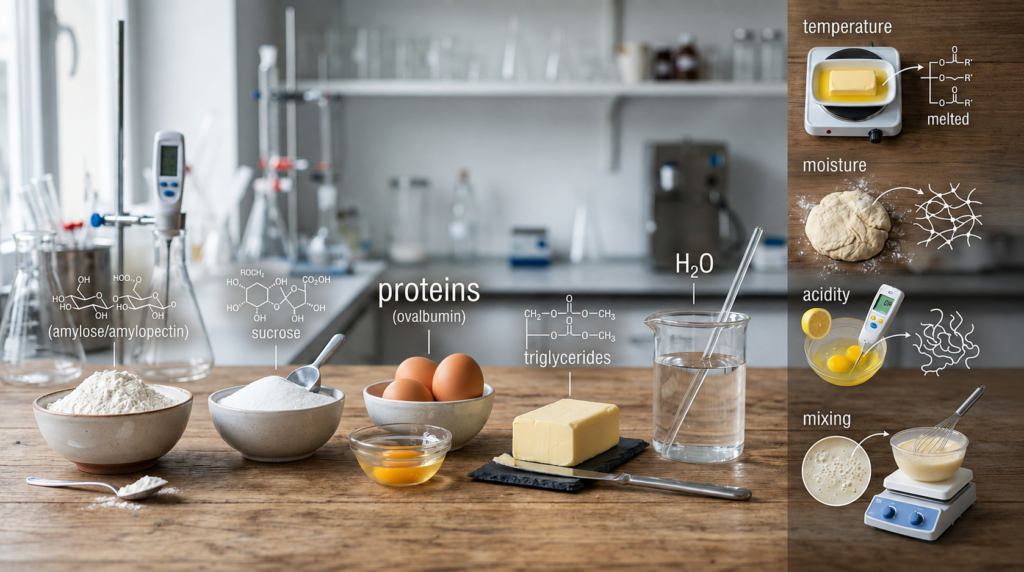
Strip it down and it’s just the study of what happens when you mix stuff, heat it, cool it, or let it ferment. Flour, Eggs, Sugar, Butter, whatever’s sitting in your fridge right now. Honestly all of it is built from proteins, carbs, fats, water, minerals, pigments.
A slight change in temperature, moisture, acidity, or even mixing can significantly change the final result of a recipe. Any of that, and you’ve shifted how those molecules are behaving toward each other.Take an egg, heat rearranges the proteins until it firms up and that’s a real structural change, not just “it got hot, whatever.”
Mix flour with water, you kick off gluten formation. Heat sugar on its own, you get caramelization. Heat sugar next to protein, you get the Maillard reaction instead totally different pathway. Own flavors, Own colors, none of this is some random kitchen trick that just happens to work.
Not Everything’s a “Reaction,” Though
Here’s one thing people usually skip past. Not every change in a kitchen is a chemical reaction. Some of it’s just physics, plain and simple.Melting butter physical change. Nothing new forming, it’s just switching states. Water evaporating off a simmering sauce, same story, still just physical.
But protein denaturation that’s a real restructuring, molecule by molecule. Caramelization and Maillard actually build brand new compounds that weren’t sitting in the pan a minute earlier. And yeast fermentation is its own separate thing entirely, because there’s an actual living organism in there, doing metabolic work.
Burping out gas, more or less, as a byproduct. So cooking sits in this weird overlap chemistry, physics, a little biology thrown in. Which is probably exactly why it’s so satisfying and so infuriating, depending entirely on the day you’re having.
The Maillard Reaction: Why Browned Food Just Tastes Better
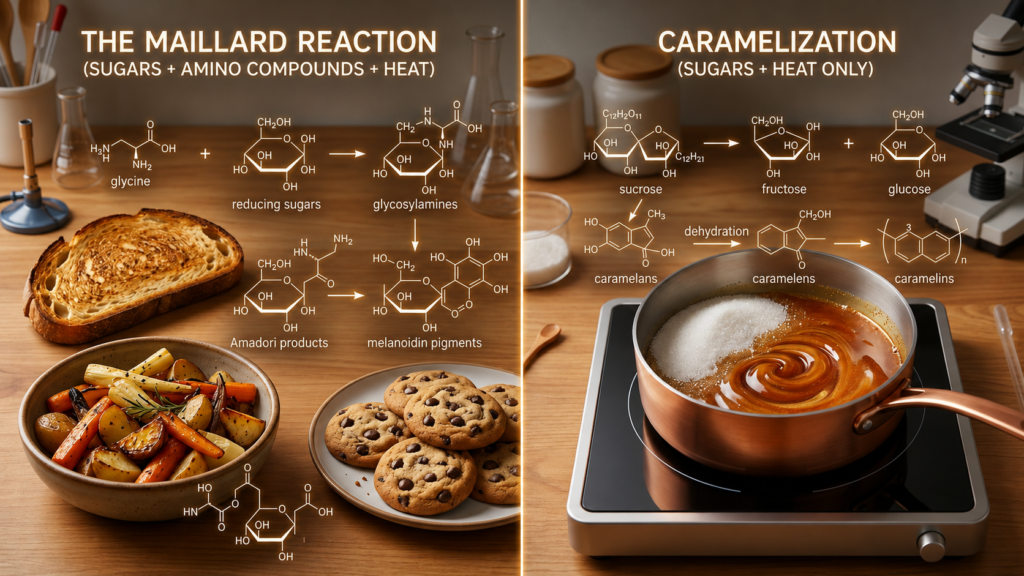
If one reaction deserves the credit for “why does this taste incredible,” it’s this one, hands down. The Maillard reaction kicks in when amino compounds the building blocks of protein react with reducing sugars, usually with heat pushing everything along. What comes out the other end is a massive range of new flavor and aroma compounds.
Plus that golden brown color everyone associates with food that’s actually done right. The crust on a good cookie, all of it traces back here, in some form or another. It’s not one clean textbook reaction you could neatly balance on paper it’s more like hundreds of smaller reactions all firing off at once.
That’s exactly why browning tastes so layered instead of like one flat, single note. A 2025 review on the topic pointed to temperature, exposure time, pH, and water activity as the big variables deciding how the whole thing unfolds.
Maillard vs. Caramelization
People mix these two up all the time. Fair enough both end in brown food. Both smell incredible while they’re happening, which doesn’t help. But Maillard needs two different things reacting together, sugar and amino compounds. Caramelization only needs sugar.
When sugar molecules break apart and reform, purely from heat, no protein involved anywhere. Both matter hugely for flavor, the American Chemical Society lists both as central to how cooked food develops taste. Chemically though two completely separate roads that just happen to look kind of similar once you get to the end.
What Actually Happens When You Caramelize Sugar
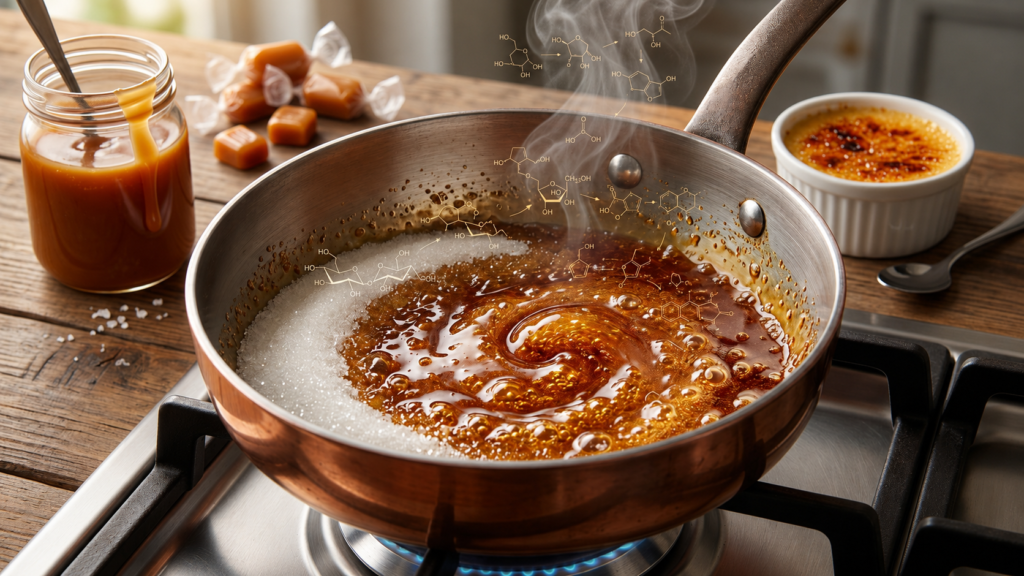
Heat sugar long enough and it stops being “just sweet stuff that got hot.” It starts breaking down, molecule by molecule degrading, recombining, forming brand new compounds that flat out weren’t there a moment ago. That’s where caramel gets its deep color and that faint bitter edge sitting underneath all the sweetness.
Caramel sauce, Caramel candy, the toasted sugar top on a crème brûlée. Even the char on a roasted peach.What you end up with depends a ton on how hot you go, and for how long. Five extra seconds on the stove genuinely, that’s the whole line between perfect caramel and, well.
Baking Soda, Baking Powder, and the Acid-Base Thing That Makes Food Rise
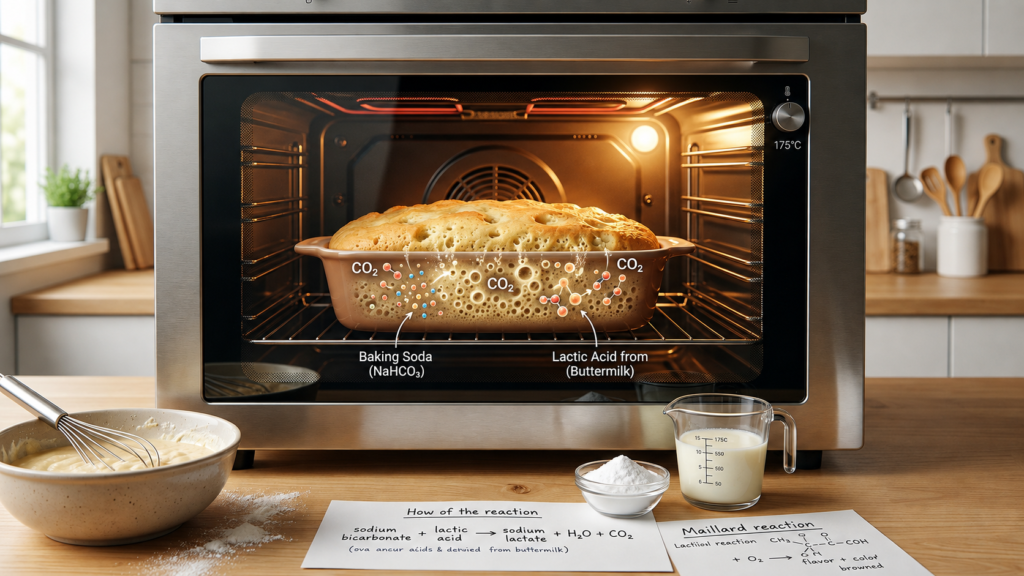
Leavening’s probably the most visible chemistry happening anywhere in your kitchen. You can basically watch it, if you’re paying attention. Baking soda is sodium bicarbonate. A base, pair it with something acidic buttermilk, yogurt, lemon juice, even brown sugar and it releases carbon dioxide. Those bubbles get trapped in the batter, expand as it heats up.
.Baking powder works a bit differently. Already’s got an acid and a base packed together, and most store bought versions are built to react in two stages once when it gets wet, again once oven heat actually hits it. Which is also exactly why swapping soda for powder, without changing anything else, tends to go badly. You’re not just swapping an ingredient.
Yeast and Bread: Basically Live Biochemistry
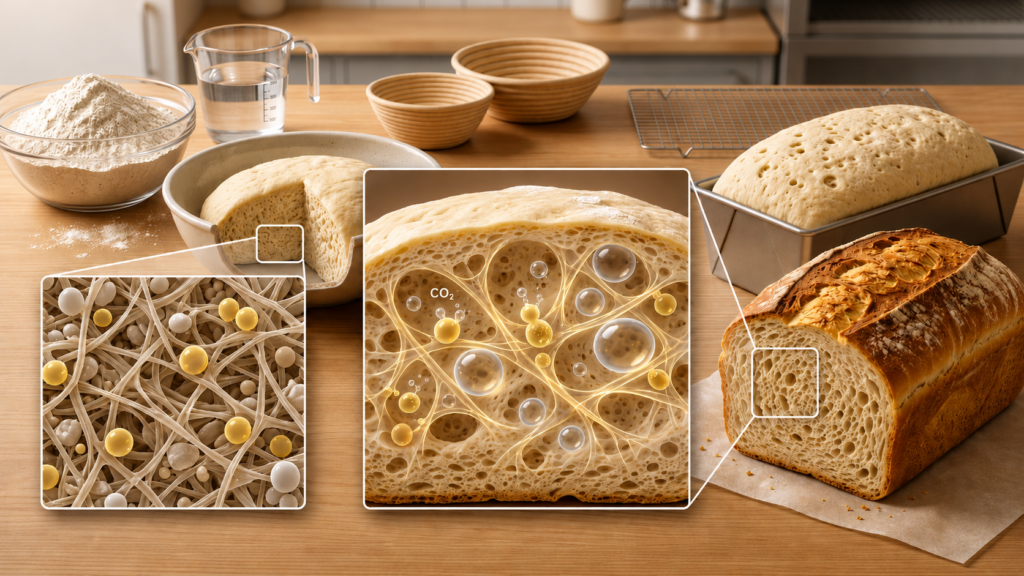
Bread-making’s probably the closest a home cook ever gets to running an actual biology experiment in their own kitchen. Yeast’s alive, it eats the sugar sitting in the dough, and as a byproduct, produces carbon dioxide and a bit of ethanol. That gas is what makes dough rise.
But yeast can’t pull it off on its own without something holding that gas in, it’d just bubble off and vanish into the air, no lift at all. That’s gluten’s job, wheat flour’s got two key proteins, glutenin and gliadin. And once you add water and start kneading, they link up into this stretchy network.
Strong enough to trap the gas the yeast’s producing. The whole reason your loaf puffs up instead of just sitting there, flat and disappointing. Short version yeast makes the gas, gluten holds onto it, heat locks the whole structure in place for good. Bread rising isn’t one ingredient pulling off a solo act. It’s a team effort a microorganism, some proteins, water, heat, all working together they realize it or not.
Gluten: Why Some Dough Stretches and Some Just Won’t
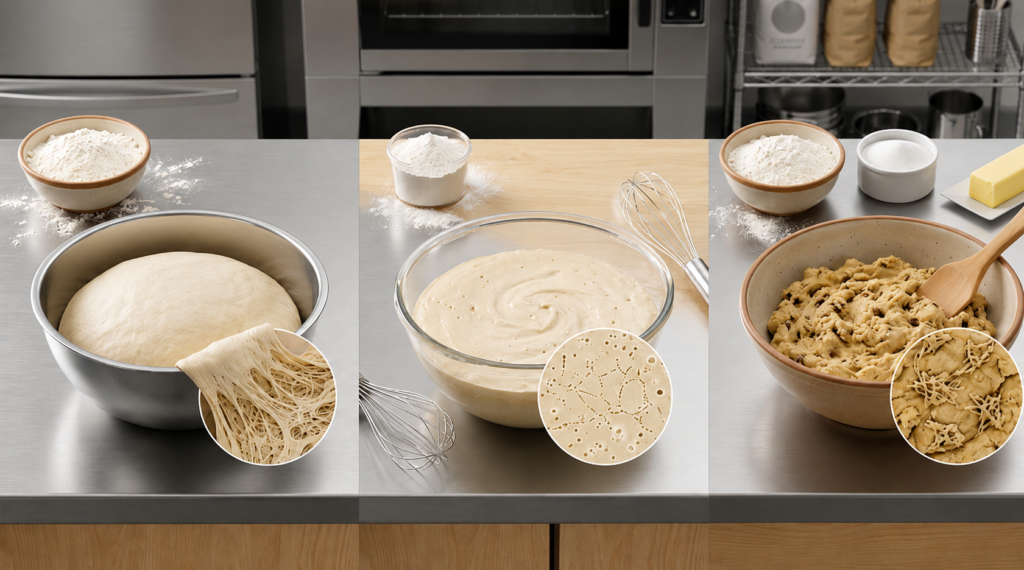
Gluten gets its own section because it acts so differently depending on what you’re actually making with it. Flour meets water, gluten-forming proteins start linking up, kneading pushes that network further along. More development, stronger and stretchier dough great for holding gas bubbles.
Not so great if what you actually wanted was something delicate. That’s why bread dough gets kneaded hard you want that strong network while cake batter gets handled gently, because too much gluten turns your cake dense and tough instead of soft and light. Cookies land somewhere in between.
Enough structure to hold shape, not so much it turns chewy. Also exactly why recipes love saying “mix until just combined.” That phrase exists purely so you don’t overdevelop the gluten without meaning to.
Why Heat Turns a Runny Egg Solid
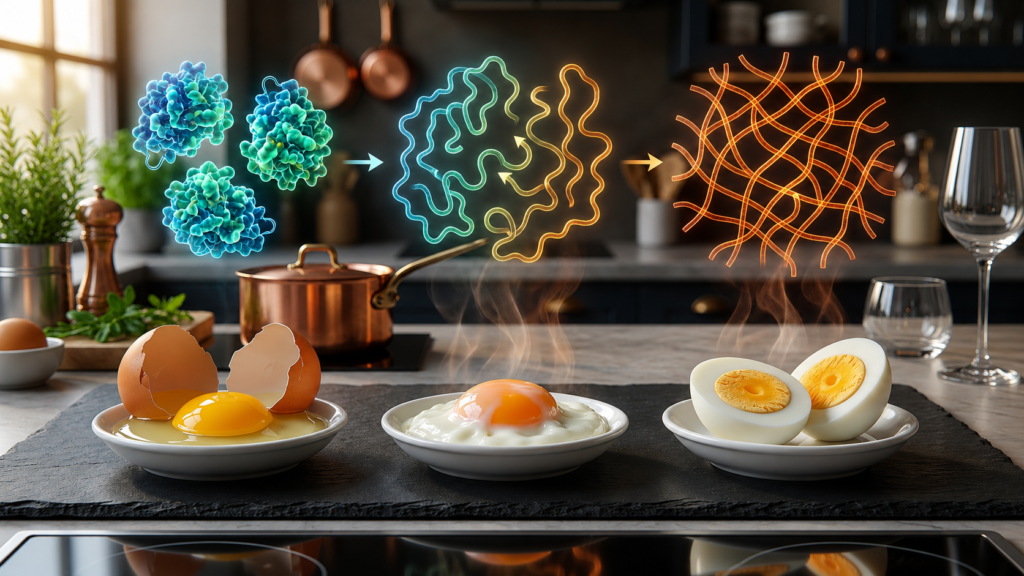
Eggs are honestly a great case study here. A 2025 article in the Journal of Chemical Education used eggs to walk through denaturation, coagulation, emulsification, and foaming, all at once. Says something about how much is packed into one small egg, really, when you think about it.
Short version raw egg proteins are folded up into specific 3D shapes. Heat unfolds them, once unfolded, they bump into each other, form new bonds. That’s denaturation, then coagulation and it’s why a raw egg goes from translucent liquid to opaque and solid.
Whether you end up with silky custard or rubbery, overcooked, sad scrambled eggs comes down to how much heat, for how long. And what else got mixed in along the way. Milk and sugar both slow the whole thing down, which is part of why custard recipes are so particular about it.
Starch Gelatinization: Why Pasta Isn’t Crunchy Anymore
Starch doesn’t get talked about nearly as much as protein does. But it’s doing serious, unglamorous work everywhere bread, pasta, rice, sauces, puddings. Heat starch granules in water, they absorb it, swell up, eventually lose their original rigid shape, that’s gelatinization. It’s why raw flour and water paste turns into something with actual texture once baked, and dry.
Brittle pasta softens after a few minutes in boiling water. Studies on cooked pasta actually show water working its way inward while starch swells outward, from the inside a decent enough. Mental picture for something happening at a scale nobody can really see with their own eyes.
Water Deserves More Credit Than It Gets
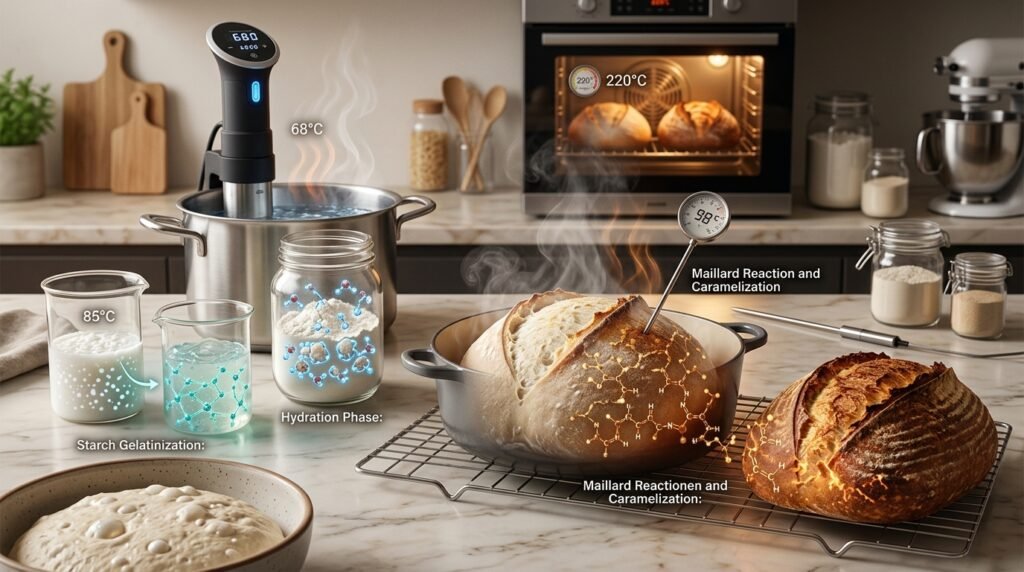
Easy to write water off as the boring, neutral one, just kind of sitting there in the background. Honestly, it’s arguably the single most important ingredient in the whole kitchen. Hydrates flour so gluten can even form in the first place. Lets starch swell, gives proteins room to interact.
Turns to steam, which helps baked goods expand. It also shapes browning the Maillard reaction depends heavily on how much free water’s floating around. Which is part of why two things cooked at the exact same temperature can brown at wildly different speeds, depending on how moist the surface actually is.
Temperature Controls Almost Everything Else
One dial decides how a dish turns out more than any other, and that’s temperature. Picture a cookie baking in a matter of minutes, butter softens and melts, water starts evaporating off, leavening kicks in, proteins denature, starch gelatinizes, the surface dries out, browning ramps up.
All of it happening more or less at once, at different speeds, depending entirely on how hot things get, and how fast they get there. Temperature’s not just “how cooked is this.” It’s the thing deciding which chemical processes even get a shot at happening at all, and in what order they show up.
Emulsions: Getting Oil and Water to Behave
Oil and water famously don’t mix. Not until you force them to, with the right technique and a helper ingredient doing the heavy lifting. An emulsion’s what happens when one liquid ends up dispersed. As tiny droplets inside another liquid it wouldn’t normally combine with.
Egg yolk’s the classic emulsifier here it’s got molecules that can grab onto both oil and water at the same time, holding the whole thing together. That’s the entire trick behind mayonnaise. Tiny oil droplets, suspended in a water-based base, held there by the yolk doing all the actual work.
Same principle shows up in dressings, creamy sauces, tons of processed food. And it’s exactly why just whisking oil and water together gives you a mess that separates right back out in a few minutes. You need something actually bridging the two not just brute force and a whisk.
Acidity and pH: The Quiet One Nobody Really Notices
Acids and bases shape flavor, texture, color way more than people usually give them credit for. Lemon juice, vinegar, yogurt, buttermilk all acidic. Baking soda sits over on the alkaline end. Put those two together, they react, release carbon dioxide, which is the leavening trick from earlier.
But pH also nudges browning, texture, even how tender or tough certain proteins end up. Because pH touches so many different reactions at once, swapping one acidic ingredient for another in a recipe can shift more than just the tang. Can change the color,the texture, the rise all in one move you probably didn’t even realize you were making.
Cooking Is Genuinely Just Applied Chemistry
See it this way, and a recipe stops reading like a shopping list, starts looking more like a controlled experiment. Change the temperature, the time, the ratios, the pH, the moisture, the mixing you’ve changed the exact conditions every single reaction above depends on.
That’s why one small substitution can wreck an entire dish, and why professional bakers weigh their ingredients out instead of eyeballing them the way the rest of us do at home half the time.
The University of Minnesota’s open-access cooking chemistry textbook makes basically this same argument. Tying everyday cooking back to acid-base chemistry, catalysis, fermentation, caramelization, Maillard. Which is proof this isn’t just some cute metaphor it’s genuinely how food scientists actually think about a kitchen.
Quick Reference Table
| Process | What’s Involved | What Happens | Everyday Example |
|---|---|---|---|
| Maillard reaction | Reducing sugars + amino compounds | Produces browning, aroma, flavor compounds | Toasted bread, seared meat |
| Caramelization | Sugar + heat | Sugar molecules break down and recombine | Caramel sauce |
| Fermentation | Yeast + sugar | Produces CO₂ and ethanol | Bread dough |
| Protein denaturation | Protein + heat | Structure unfolds and reforms | Cooked egg |
| Starch gelatinization | Starch + water + heat | Granules absorb water, swell up | Pasta, rice |
| Acid-base reaction | Acid + base | Releases CO₂, shifts pH | Baking soda + buttermilk |
| Emulsification | Oil + water + emulsifier | Stabilizes a mixed liquid system | Mayonnaise |
Why Any Of This Actually Helps You Cook Better
Don’t need to memorize a single term here to become a better cook. But having even a rough mental model changes how you troubleshoot when something goes sideways on you.
Bread didn’t rise, could be dead yeast. Could be dough that sat too cold, or too hot, to ferment right. Could be a gluten network that never developed enough to hold gas in the first place.
Cookies came out pale, probably not enough surface moisture lost. Or your oven’s running cooler than the dial claim mine definitely does, I’ve stopped trusting it entirely. Or there just wasn’t enough sugar in the mix to drive browning along properly.
Cake turned dense, overmixed, most likely, too much gluten. Or under-leavened,or the ratios were simply off in a way that changed how the whole structure set in the end.
Egg went rubbery, too much heat, applied too fast, nothing in the mix to slow the coagulation down. Instead of blaming bad luck or blaming yourself, which people love doing for some reason you can actually trace it back, figure out what went wrong, step by step.
Wrapping This Up
Every time you cook, you are essentially carrying out a chemistry experiment without even realizing it. Proteins unfold, starch swells, yeast produces carbon dioxide, and sugar changes when exposed to heat. As food browns, new compounds form and create different aromas and flavors.
The Maillard reaction gives seared and toasted foods their rich flavor, while caramelization transforms simple sugar into a deeper and more complex substance. Gluten provides structure to bread, yeast helps it rise, and the chemistry of starches and proteins determines the texture of many foods we eat.
None of this makes cooking any less of an art. If anything, knowing what’s happening underneath gives you more control over it, not less. Once you know why something happens, your kitchen stops being pure guesswork and starts being somewhere you can actually predict outcomes most of the time, anyway. Nobody gets it right every single time. Honestly, that’s fine too.
Real Life Examples
Case Study 1: Caramelization
Caramelization is the breakdown of sugar under conditions of high temperatures. This process imparts the golden brown color and flavor of caramel. In contrast to the Maillard reaction, no protein is required for the caramelization reaction.
Case Study 2: Why Does Cake Rise?
When baking soda is added to the acidic ingredients, such as yogurt, lemon juice or buttermilk, carbon dioxide (CO₂) is released. The gas creates bubbles in the batter that swell when it is baked. The bubbles make the cake rise and make it light and fluffy.y.
Frequently Asked Questions
What is the chemistry behind cooking and baking?
The chemical and physical changes ingredients go through when they hit heat, water, acids, bases, or microorganisms. All of it shapes flavor, texture, color, aroma, in the end.
What reaction makes food turn brown?
Usually the Maillard reaction sugar plus amino compounds or caramelization, which is just sugar breaking down from heat alone. Look similar on the plate. Completely different routes to get there.
Why does baking soda make things rise?
Reacts with an acid, releases carbon dioxide, and those bubbles expand inside the batter as it bakes in the oven.
What’s chemically happening when bread rises?
Yeast ferments sugar in the dough, produces carbon dioxide. Gluten network traps that gas so the dough can actually expand instead of just deflating flat.
Why does an egg go solid when you heat it?
Heat unfolds the egg’s proteins, and once unfolded, they bond with each other in new ways. Denaturation, then coagulation.
What’s the real difference between caramelization and Maillard?
Caramelization’s just sugar breaking down under heat, nothing else involved. Maillard needs sugar and amino compounds reacting together. Both brown food, genuinely not the same process, though.
Why does pH matter so much in baking?
Touches leavening, browning speed, texture, flavor, all at the same time. Change the acidity, you’re really changing several things at once, whether you meant to or not.
Why should a home cook even bother with any of this?
Because it turns guessing into actual troubleshooting. Once you get what’s driving a texture or a flavor, you can fix it next time instead of just hoping for the best.
Conclusion
Cooking and baking are more than just following recipes they are everyday chemistry. Heat, water, proteins, starches, fats, and sugars work together to create the flavors, textures, colors, and aromas we enjoy in our food. Every step, from mixing ingredients to heating them in the oven, causes chemical changes that affect the final result.
Understanding these simple chemical processes helps explain why bread rises, why cookies turn golden brown, why eggs change texture, and why cakes become soft and fluffy. It also shows why small changes in temperature, moisture, ingredients, or timing can make a big difference in cooking and baking.
Once you understand the chemistry behind cooking and baking, the kitchen becomes more than a place to prepare food. It becomes a place where science happens every day. The next time something goes wrong in the kitchen, you may not need to blame your recipe or your luck. A better understanding of the chemistry may help you figure out what happened and how to get a better result next time.