
Introduction
Stand in the skincare aisle for long enough and you’ll start to feel.The pressure to purchase a serum, essence. And three different types of acid to leave your house. Most people believe some variation of that formula. It’s not really their fault,beauty marketing runs on the idea. That more steps and more products equal more results but that’s not really.
What dermatologists say when you actually ask them,an everyday skincare routine. At the level that matters most, comes down to three things.Cleansing, Moisturizing, Sun protectionafter that, it’s optional and not lesser, it’s optional.
Meaning it depends on your skin, your budget and how much time you want to spend on this before coffee actually. A breakdown of what a good routine should be like. Along with some of the considerations of the different skin types.
What to understand and what to forget about, and a few habits that eat away at all of the above. None of this promises perfect skin, because honestly nothing can. What it can offer is a routine you’re still doing in six months, which turns out to matter more than most people assume.
An Everyday Skincare Routine?
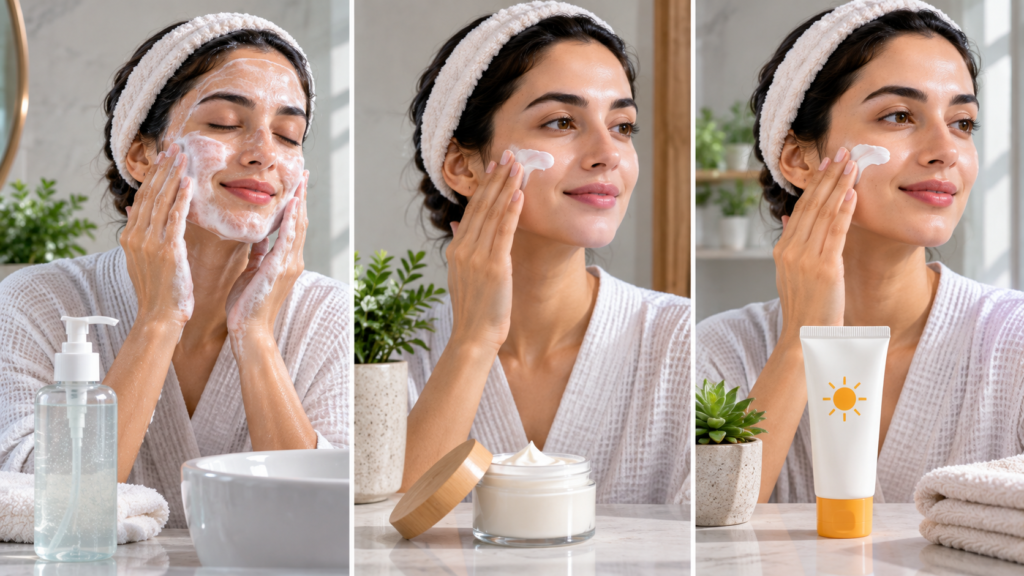
Remove the brand and an everyday skin care regimen is a series of steps. That clean, help maintain the moisture barrier and shield your skin from the sun. There’s no approved product list attached to it.
Dermatologists at the University of Miami and USC have both described roughly the same three part shape. When asked about it cleanse, moisturize, protect and whatever gets layered on beyond. That is a decision about your particular skin, not a requirement everyone shares.
Here’s the part people underrate. Doing three simple steps every single day beats an elaborate ten-step routine done three times a week. Skin responds to patterns built up over weeks and months. It doesn’t much care how good any one application was.
Why a Simple Skincare Routine Matters
Simplicity gets treated. Like a compromise, and it shouldn’t. There are two real problems that come out of overcomplicating things. One is irritation layer enough active ingredients at once and the odds go up that something fights with your skin.
The other, which arguably is more common, is one that feels like, a chore is dropped. After a few weeks, regardless of how well-intentioned they started out. For just this reason, dermatology advice continually boils down to gentleness.
Skip the harsh scrubbing. Skip the alcohol-heavy formulas. Don’t wash more than you need to, because irritated skin tends to look worse than skin left alone. If you don’t have a diagnosed skin condition, a simple routine isn’t the beginner version you eventually graduate out of. For most people it’s just the right amount, full stop.
Morning Skincare Routine
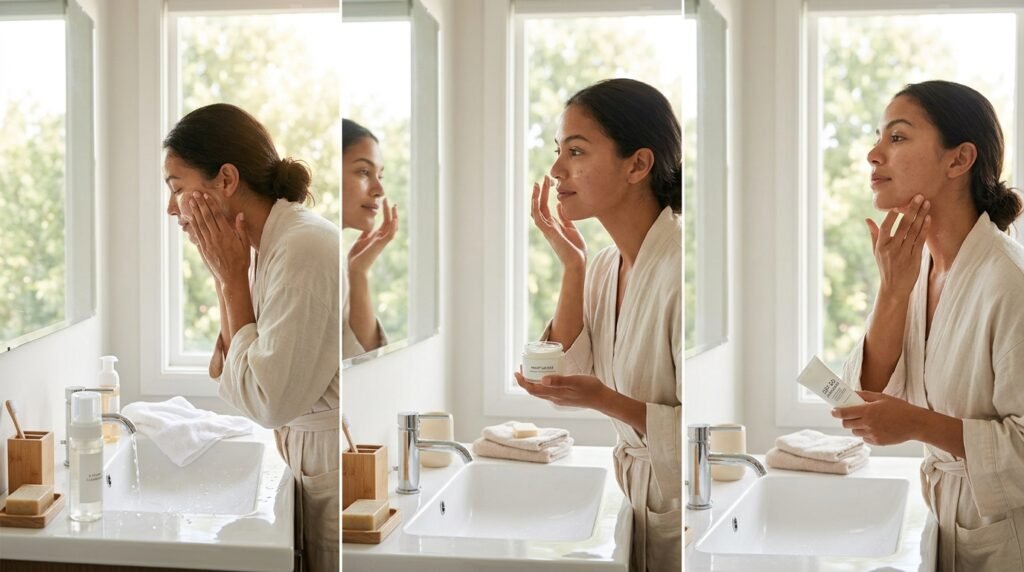
Step 1: Cleanse
Your face collects oil overnight, so a morning wash is mostly about clearing that away and giving whatever comes next a clean surface. The American Academy of Dermatology recommends something gentle, non-abrasive, and alcohol-free, applied with lukewarm water using your fingertips rather than a wash overnight, your face produces oil.
So washing your face in the morning will essentially be getting rid of some of that and preparing your face with something clean for the rest of your day. The American Academy of Dermatology suggests using something that is not soothing, not abrasive.
And not containing alcohol, and that is applied with your fingertips and lukewarm water. Not a washcloth or scrub brush.cloth or scrub brush. Both of those tend to irritate skin more than they clean it satisfying as scrubbing can feel, it’s usually working against you.
Step 2: Moisturize
Yes – even oily skin. Moisturizer keeps the outer barrier in place and helps prevent water from escaping using it is not a way to make oily skin less so.
Sometimes, it does the exact opposite. If the skin is not properly moisturized, it will over moisturize itself. A light-weight, oil-free, non-comedogenic formula generally suffices without adding any shine on top of it.
Step 3: Apply Sunscreen
Of everything in this article, this is the step backed. By the most evidence, and it isn’t close. UV radiation is tied to sunburn, premature aging, and skin cancer risk.So daily protection isn’t optional the way some “advanced” products are.
According to the FDA, broad-spectrum sunscreens guard against both UVA and UVB radiation, while SPF on its own mostly reflects UVB protection. The AAD’s recommendation is specific broad-spectrum, water-resistant, SPF 30 or higher, applied daily, reapplied roughly every two hours outdoors and sooner after swimming or heavy sweating.
Want to combine steps? A tinted moisturizer or a moisturizer-sunscreen hybrid can work as long as it actually clears that SPF and broad-spectrum bar, not just borrows the word “protection” somewhere on the label.
Evening Skincare Routine
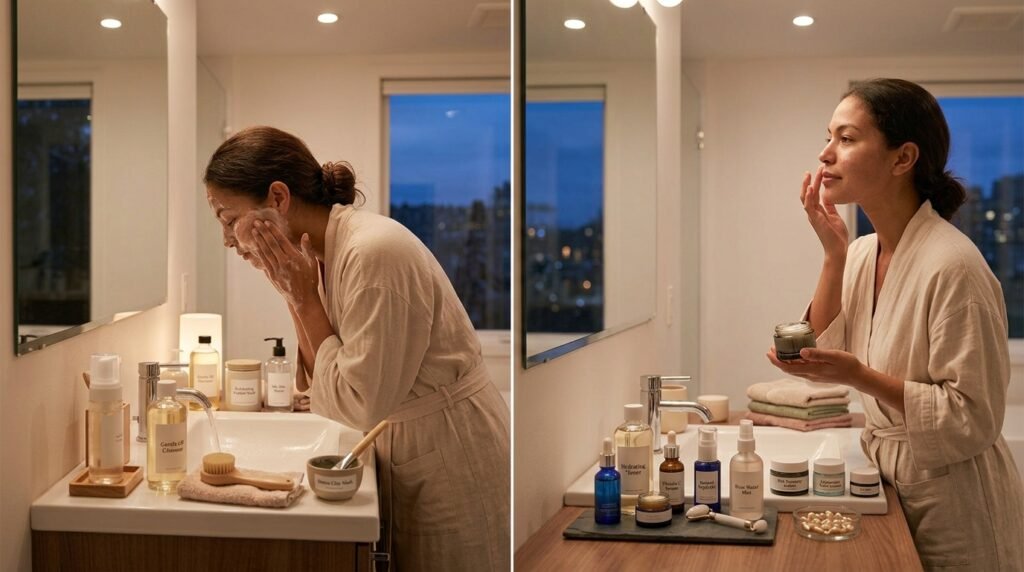
Cleansing
Evening cleansing does a different job than the morning version.Washing away sunscreen, makeup, pollution, sweat & oil, not just overnight. The same rules will apply lukewarm water, fingertips, no scrubbing. Even when you are just done and ready to go to sleep.
Targeted Products
Retinoids and gentle exfoliating acids belong here, and neither is required for a basic routine. If you’re going to add one, add it alone. Stack two or three new actives at once and, the moment your skin reacts, you won’t have a clue which product actually did it.
Moisturizing
Night moisturizer can run a bit richer than what you’d use during the day, mostly since there’s no sunscreen or makeup underneath competing for space. Either way the job stays the same support the barrier while skin does its overnight repair work.
How to Choose Products for Your Skin Type
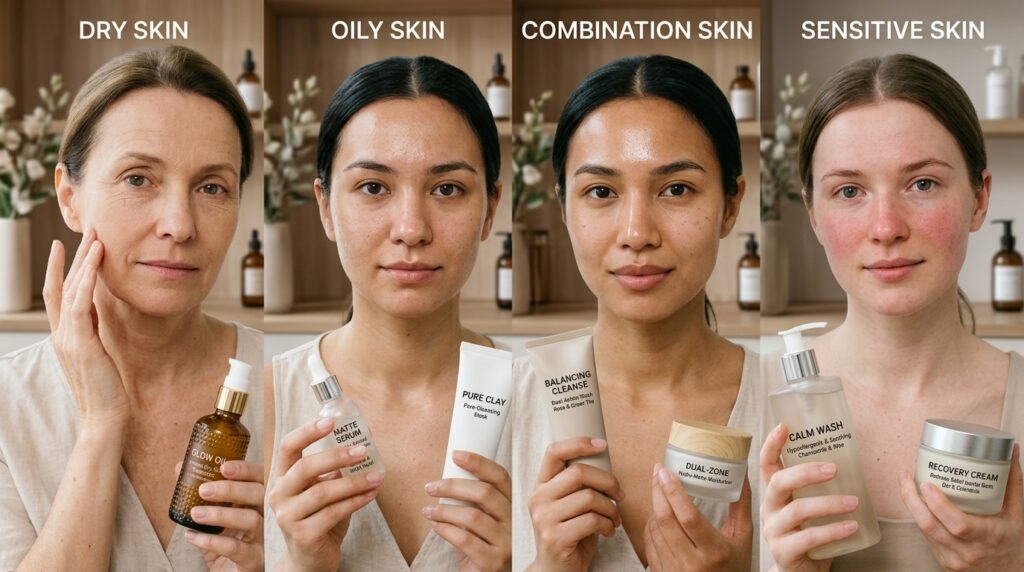
The AAD classify skin into five broad categories: oily, dry, normal, combination, sensitive.Use this as the basis for shopping. The AAD classifies skin into five distinct types, including normal, dry, oily, combination, and sensitive skin.c types: normal, dry, oily, combination, sensitive.
Consider this as a broad beginning guide for buying, not a set label; skin type varies more than individuals realize and is influenced by age, hormones, season, and climate. Skin type useful product characteristics common considerations Dry Richer, cream-based moisturizers.
Avoid over-cleansing and hot water Oily Lightweight, oil-free, non-comedogenic formulas Avoid skipping moisturizer entirely Combination Balanced textures, sometimes different products by area.
Zones may need different approaches Sensitive Simple formulas, fragrance-free where possible Introduce new products cautiouslyot a fixed label – skin type moves around more than people expect, pushed around by climate, season, hormones, and age.
Choosing Products Based on Your Skin Type
| Skin Type | Useful Product Characteristics | Common Considerations |
|---|---|---|
| Dry | Richer, cream-based moisturizers | Avoid over-cleansing and hot water |
| Oily | Lightweight, oil-free, non-comedogenic formulas | Avoid skipping moisturizer entirely |
| Combination | Balanced textures, sometimes different products by area | Zones may need different approaches |
| Sensitive | Simple formulas, fragrance-free where possible | Introduce new products cautiously |
Dry Skin
Richer moisturizers help here, often built around ceramides or glycerin. Cut back on long hot showers too, or washing more than necessary both strip oils faster than skin can replace them.
Oily Skin
The AAD’s guidance: cleanse up to twice a day plus after sweating, favor oil-free and non-comedogenic products, and go easy on things like salicylic or glycolic acid. Genuinely useful ingredients. Also genuinely easy to overuse and end up worse off than when you started.
Combination Skin
Often the T-zone acts differently than the remainder of the face. Though that doesn’t immediately imply two whole routines running simultaneously. While some prefer something lighter where they get oily. Many get by fine with one balanced moisturizer across the whole face. Both are quite sensible.
Sensitive Skin
Keep formulas simple, bring in anything new one product at a time. Fragrance-free tends to be the safer bet the AAD specifically points toward fragrance-free. Rather than “unscented” for anyone with eczema or fragrance sensitivities, since unscented products can still hide masking fragrances that trigger the exact same reaction.
Essential vs. Optional Skincare Items
Some skincare products are essential for a basic routine. A gentle cleanser, moisturizer, and broad-spectrum SPF 30+ sunscreen are the key products you should not skip. Exfoliating acids, retinoids, vitamin C serums, eye cream, toner optional and fully depending on what you’re really aiming to achieve.ound it.
Cleanser, moisturizer, broad-spectrum SPF 30+ sunscreen. Optional, and entirely dependent on what you’re actually trying to accomplish: exfoliating acids, retinoids, vitamin C serums, eye cream, toner. None of it is required for healthy-looking skin. Adding more of it doesn’t automatically improve a routine past a certain point it mostly just raises the odds something irritates you.
How to Understand Common Skincare

Ingredient marketing likes to imply piling on more actives always means better results. In practice each one does a fairly narrow job, and knowing which job matters more than owning all of them ever will.
Ceramides
Ceramides are lipids that are naturally present in the outer layer of the skin. They form a part of the so-called barrier which prevents excessive water loss. Research into the structure of the skin and its barrier properties considers ceramides as an integral element of it, which points to their importance for normal function.
Low levels of these lipids are associated with impaired barrier function, increased water loss. And higher reactivity and permeability of the skin. This is why topically applied moisturizers containing ceramides. Are commonly suggested for people with dry skin or those whose barrier has been compromised.
Glycerin and Hyaluronic Acid
Glycerin is a humectant, draws water into the skin’s outer layer, shows up in moisturizers across nearly every skin type going. Hyaluronic acid does something similar pulls and holds moisture at the surface but it’s not a swap-in for a moisturizer that also seals that moisture in.
Niacinamide
Constantly included in various serums for the reinforcement of the skin barrier and leveling of the skin tone is niacinamide, better known as vitamin B3. This substance is generally well tolerated, but it can cause irritation. If used in high concentrations or in combination with other strong acids.
Salicylic Acid
Salicylic acid is a beta-hydroxy acid, commonly reached for with oily or acne-prone skin. Useful in the right amount. Drying and irritating past it.
Alpha Hydroxy Acids
Alpha hydroxy acids glycolic acid, lactic acid handle gentle exfoliation. Usually introduced slowly for more or less the same reason niacinamide gets introduced carefully.
Retinoids
Retinoids, vitamin A derivatives, get the credit for changes in texture and fine lines over time. They also raise sun sensitivity, which is the whole reason they go on at night, paired with daily sunscreen, no exceptions worth making.
Vitamin C
Vitamin C is an antioxidant some people build into mornings, though how stable and effective it actually is depends heavily on the specific formulation you’ve bought.
Fragrance and Essential Oils
Fragrance “natural” fragrance and essential oils included is one of the more common triggers for irritation and allergic reaction. Sensitive skin especially.
None of this is required across the board for everyone. What actually matters is landing on the handful that fit your skin, your tolerance, and whatever you’re trying to get out of a routine not counting ingredients printed on a label like it’s a scoreboard.
Common Skincare Mistakes

Over-cleansing, or scrubbing too hard typical Errors in Skincare.Over-cleansing, or aggressive scrubbing, usually harms the exact barrier it seeks to protect., tends to damage the exact barrier it’s supposed to protect.
.Adding several new actives at once means that when something irritates you and eventually something will good luck figuring out which product is responsible.Ignoring irritation instead of pausing whatever’s causing it, hoping it settles on its own.
It usually doesn’t skipping sunscreen on cloudy dayIgnoring annoyance instead of stopping whatever is irritating and hoping it just goes away on its own. Usually it doesn’t,choosing not to wear sunscreen on cloudy days or when you are mostly inside close to windows. The fact that the sky seems gray doesn’t mean UV stops.
When you’re mostly indoors near windows. UV doesn’t stop just because the sky looks gray.Copying a viral routine built for somebody else’s skin, not yours.Buying based on words like “miracle” or “instant”.
Rather than what an ingredient actually does once it’s on your face.Assuming oily skin doesn’t need moisturizer which in practice just means skipping a step quietly doing real work in the background.
How to Build a Routine on a Budget
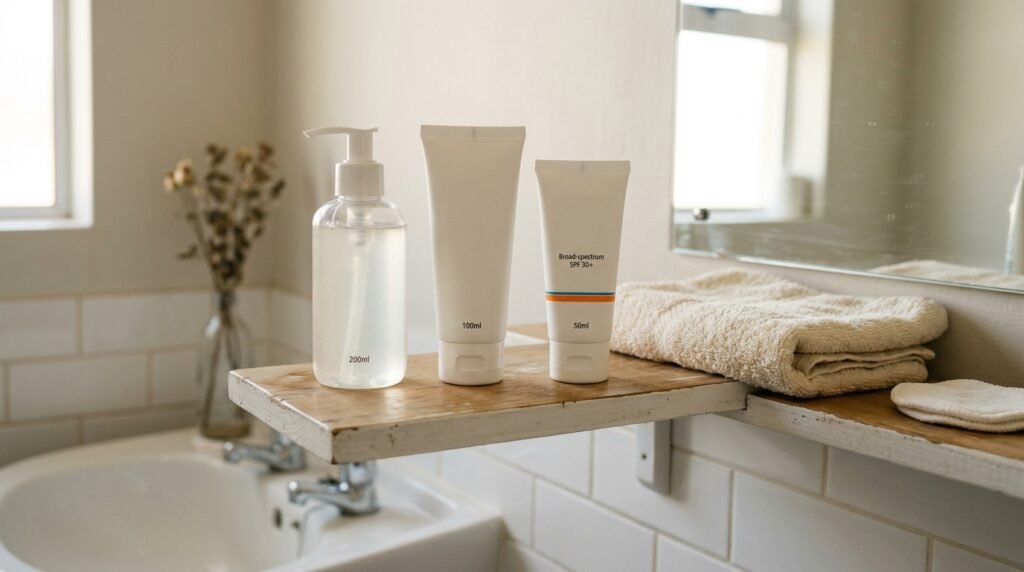
A genuinely complete routine fits in three products: a gentle cleanser, a basic moisturizer, a broad-spectrum SPF 30+ sunscreen. None of them need a premium price tag to worHow to Make a Schedule on a Budget
Three items a mild cleanser, a basic moisturizer, a broad-spectrum SPF 30+ sunscreen comprise a really whole regimen. None of them call for a high price tag to function.
SPF value, broad-spectrum labeling, and how frequently you really apply it not. What is written on the bottle or how much it cost determine sunscreen efficacy. Later, would you like to grow with an exfoliant or a retinoid.
Sunscreen effectiveness comes down to SPF value, broad-spectrum labeling. And how consistently you actually put it on not what’s printed on the bottle or how much it cost you. Want to expand later with a retinoid or an exfoliant. Fine, once the basics are locked in, not something worth rushing before they are.
How to Introduce New Products
Bring in one new product at a time, spaced a week or two apart, so if something reacts badly you actually know what caused it. For anything you’re planning to use long-term, a patch test a small amount on an inconspicuous spot for several days before.
It goes anywhere near your face is a fairly low-effort way to catch a problem early. Redness, burning, itching, new breakouts after adding something stop using it. Pushing through irritation almost never turns out to be worth it in the end.
When to See a Dermatologist
A good routine supports healthy-looking skin. It was never built to replace medical care, and it can’t. Book a visit with a board-certified dermatologist if acne isn’t responding to basic care. If there’s an unexplained rash, a mole that’s changed in size, shape, or color, irritation.
That hasn’t calmed down even after everything’s been simplified or really any skin concern actually affecting daily life. Nothing here is meant to diagnose anything. That’s a job for someone who can examine your skin in person, not an article on your phone.
Real Life Examples
American Academy of Dermatology
The American Academy of Dermatology advises a straightforward skincare base: everyday broad-spectrum SPF 30+ sunscreen, mild washing, and acceptable moisturizing. This reinforces the theory that a good routine doesn’t need many items.
Sun Protection
To guard against UVA and UVB rays, dermatologists advise daily broad-spectrum sunscreen. The AAD advises using water-resistant SPF 30+ sunscreen outside and reapplying it frequently. This makes sunscreen a need for daily skincare.
Frequently Asked Questions
What is a good everyday skincare routine?
Three basics, used every day: a gentle cleanser, a moisturizer that fits your skin type, and a broad-spectrum sunscreen with SP Regularly Asked Issues
An appropriate everyday skincare regimen would be?
Used every day, three fundamentals: a mild cleanser, a moisturizer suited for your skin type, and a broad-spectrum sunscreen with SPF 30 or above.
What fundamental actions of skincare are there?
Moisturize, clean, shield with sunscreen F30 or higher.
What are the basic steps of skincare?
Cleanse, moisturize, protect with sunscreen. Exfoliants, retinoids, serums all optional, all dependent on what your specific skin actually needs from you.
Should I moisturize oily skin?
Yes, A lightweight, oil-free, non-comedogenic moisturizer supports the barrier without piling on shine, and cutting it out doesn’t reliably cut down on oil production either.
Is sunscreen part of a daily skincare routine?
Yes, and it’s the step with the strongest case behind it, honestly. Daily broad-spectrum SPF 30+ helps cut down on UV-related damage sunburn risk, premature aging, both included.
How many skincare products does a beginner need?
Three, Cleanser, moisturizer, sunscreen, everything else can wait until it’s actually needed, not before.
Conclusion
An everyday skincare routine that actually works doesn’t have to be complicated and honestly. The more complicated it gets, the less likely anyone is to keep doing it past week three.
Cleansing, moisturizing, and daily sun protection are the foundation dermatology guidance keeps landing back on, and most of what gets market. Finally an daily skincare regimen that actually works doesn’t have to be complex; in fact, the more complex it becomes, the less probable someone is to continue it past week three.
The basic dermatology advice is to clean, moisturize, and use daily sun protection. Most of what is sold beyond that is an improvement rather than a need. The actual work was never about discovering the ideal product.
It’s about creating something basic enough to last a hectic week, then modifying it as skin changes and knowing when a problem warrants a dermatologist instead of another bottle.d beyond that is a refinement, not a requirement.
The real work was never about finding the perfect product. It’s building something simple enough to survive a busy week, adjusting it as skin changes, and knowing when a concern belongs with a dermatologist instead of another bottle.